
Key takeaways
- AI is changing how people find and assess professional services firms. Your expertise now needs to be visible to AI tools as well as Google.
- Legal and financial firms face a higher standard. Google’s E-E-A-T principles make demonstrating genuine expertise and trust particularly important.
- The answer isn’t producing more generic content. It’s making the expertise you already have easier to find and understand.
Are your clients asking AI who to hire?
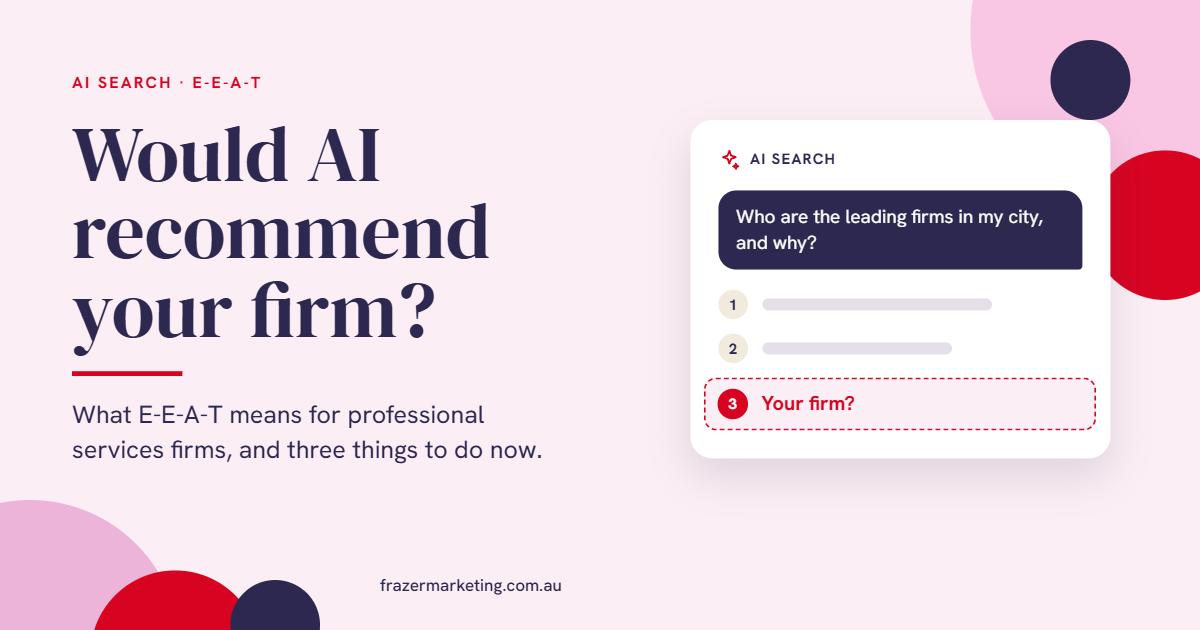
Increasingly, yes. Instead of typing “family lawyer Melbourne” into Google and scanning ten links, a prospective client can now ask ChatGPT or Perplexity for a recommendation and receive a short answer naming a handful of firms.
Try it yourself. Ask an AI tool to recommend a [your specialty] firm in [your city], then ask why it chose those firms.
Many partners I speak with have never done this, and the results often surprise them. Sometimes their firm doesn’t appear at all. Sometimes a smaller competitor with half their experience is listed first, simply because its expertise is easier to find and understand online.
Having led marketing inside both a national law firm and a national accounting firm, I know how much expertise sits in a partnership, and how little of it usually reaches the website. That’s why AI visibility isn’t a technical problem for your web developer. It’s a positioning issue, and it deserves partner-level attention.
What is E-E-A-T?
E-E-A-T stands for experience, expertise, authoritativeness and trustworthiness. It comes from the guidelines Google gives its human search quality raters, the people who assess whether search results are genuinely useful. Google added the first “E” (experience) in late 2022, recognising that first-hand experience matters as much as formal qualifications.
In practice, E-E-A-T asks four questions about your content:
- Experience: has the author actually done this work?
- Expertise: do they have the knowledge and qualifications to advise on it?
- Authoritativeness: do others recognise them as a credible source?
- Trust: is the content accurate, transparent and safe to rely on? Google describes trust as the most important of the four.
Why do legal and financial firms face a higher standard?
Google classifies legal and financial topics as “Your Money or Your Life” (YMYL). These are areas where poor information can seriously affect someone’s finances, safety or wellbeing, so Google expects stronger evidence of expertise and trust before it shows that content prominently.
For law firms, accounting firms and financial advisers, that means content written by “Admin”, vague service pages and thin lawyer profiles are more than a missed opportunity. They work against your credibility with search engines and with clients.
What are GEO and AEO, and how are they different from SEO?
SEO (search engine optimisation) helps your website rank in a list of search results.
GEO (generative engine optimisation) and AEO (answer engine optimisation) are newer terms for helping your firm appear in the answers AI tools generate. Instead of competing for a place on page one, you’re competing to be one of the few firms an AI tool names, quotes or recommends.
AI companies don’t publish exactly how their tools choose sources, and nobody outside those companies can say for certain. But the signals they appear to reward are familiar: clear answers to real questions, credible named authors, and a consistent reputation across trusted sources.
In other words, GEO and AEO aren’t a replacement for good SEO. They build on the same foundation, and that foundation is E-E-A-T.
What does recent legal sector research tell us?
The latest ALPMA research, Beyond Adoption: People, Technology and the Future of Legal Work, found that daily AI use in law firms has nearly quadrupled since 2024. If professionals are increasingly using AI every day, their clients and referrers will be too.
The report concludes that the firms that move ahead will be those that change how work is done, not those that simply add more tools. Marketing is no different, and more content isn’t the answer either. A new website or AI tool won’t fix your visibility if your expertise is still buried in PDFs, partners’ heads and blog posts by “Admin”.
Source: ALPMA, Beyond Adoption: People, Technology and the Future of Legal Work, 2026.
How can your firm become more visible in AI search?
1. Put real people behind your content
Every article should have a named author, linked to a strong profile page. That profile should show their qualifications, specialist areas, accreditations, published work, speaking and a link to their LinkedIn.
For legal and financial content, credible authorship is one of the clearest trust signals you can give. An article published by “Admin” gives readers and search engines no reason to believe it.
2. Answer the questions clients actually ask, clearly and early
List the ten questions your team hears most often from clients. Turn each one into a heading written as a question. Answer it plainly in the first two sentences, then add the detail.
Clear, direct answers are easier for both people and AI tools to understand and quote. Structured data (schema markup) can help search engines understand your pages, but treat it as good housekeeping rather than a shortcut. The quality of the answer matters more.
3. Be consistent everywhere you appear
Check that your firm name, services, locations and team bios match across your website, LinkedIn, Google Business Profile and industry directories. Inconsistent details make it harder for search engines and AI tools to be confident about who you are.
Then build credible mentions beyond your own website through industry association articles, podcasts, speaking and media commentary. A reputation built across trusted sources is difficult for competitors to copy.
How do you check whether AI recommends your firm?
It takes five minutes. Open ChatGPT, Perplexity or Google’s AI Mode and ask:
“Who are the leading [your specialty] firms in [your city], and why?”
Then ask a few of the questions your clients typically ask before they hire someone like you. Take screenshots of the answers and note three things: whether your firm appears, how it is described, and which competitors are named instead. AI answers vary from one session to the next, so repeat the test a few times before drawing conclusions.
Frequently asked questions
Does E-E-A-T directly affect Google rankings?
Not as a single score. E-E-A-T is a framework Google’s quality raters use to evaluate search results, and Google uses their feedback to improve its systems. The signals it describes, such as credible authors, accurate content and a trusted reputation, are what Google’s systems aim to reward.
Do I need a new website to be visible in AI search?
Usually not. Most firms can make significant progress by improving the content they already have: stronger lawyer and adviser profiles, clearer service pages and direct answers to common client questions.
Is GEO replacing SEO?
No. GEO builds on good SEO rather than replacing it. Many AI tools draw on search results, so the fundamentals of being findable, credible and clear still apply.
How long does it take to see results?
It depends on your starting point and how competitive your market is. Profile and content improvements can be made within weeks, but building authority across trusted sources is an ongoing investment over months.
Can we do this ourselves?
Yes. Much of the work is writing and organising content your firm already knows. Where firms usually need help is deciding what to prioritise, and keeping momentum when partners are busy with client work.
How Frazer Marketing can help
If your test results were disappointing, or you’re not sure where to start, our AI Search & E-E-A-T Visibility Audit is designed for professional services firms. We assess how your firm appears in Google and AI tools, review your website and key profiles, compare you with competitors and identify the priority gaps. You’ll receive a practical action plan in plain English, not a technical SEO report.
For firms that need more than a plan, we also provide marketing strategy and planning, outsourced marketing leadership and LinkedIn strategy for partners.
Book a 20-minute conversation to talk about where your firm stands.
Originally published by Michelle Frazer at Frazer Marketing.
About the Author
Michelle Frazer is the founder and CEO of Frazer Marketing, a strategic marketing consultancy helping professional service firms build stronger brands, attract the right clients and drive sustainable growth. Her team supports businesses with marketing strategy, brand development, digital marketing and outsourced marketing services. Michelle brings 30 years of senior marketing experience across legal, accounting, property, transport and technology sectors.
To contact Michelle Frazer, click here.