
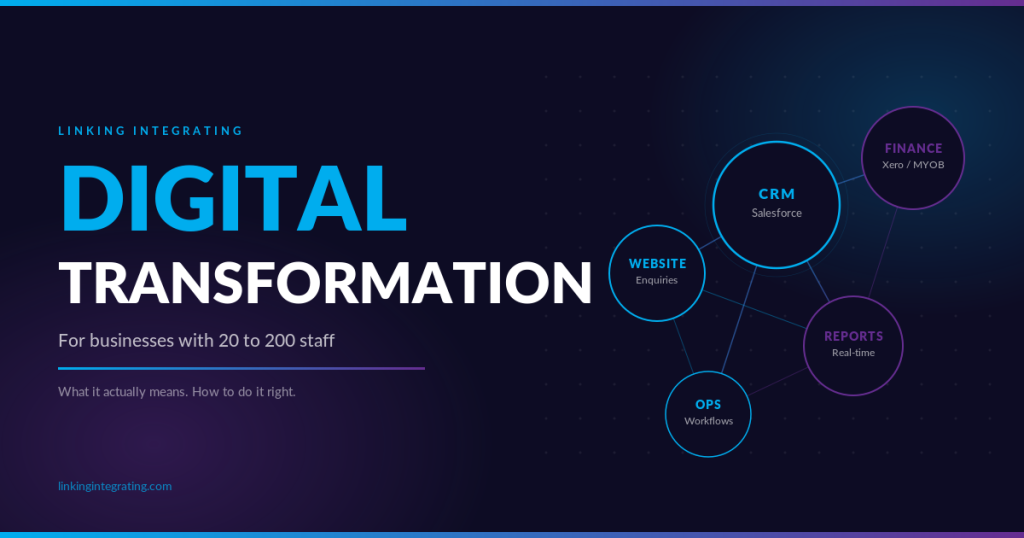
If you run a business with 20 to 200 staff and someone has told you that you need digital transformation, it is worth being clear about what that actually means at your scale, because it is not the same thing it means for a 2,000-person enterprise.
For growing businesses across Victoria, digital transformation is not a technology overhaul. It is not a new ERP system, a platform migration, or a six-month consulting engagement. In most cases, it is a series of targeted changes to how your systems connect, how data moves through your business, and how your team’s time is spent.
Here is what that looks like in practice, and how to know where to start.
Why the term causes more confusion than it should
“Digital transformation” has been used to describe everything from installing a new accounting platform to a full enterprise software replacement. For businesses your size, both of those framings are usually wrong.
Replacing everything at once is disruptive, expensive, and carries a high failure rate even when the planning is solid. But doing nothing and calling your current setup fine is equally costly, because the problems compound quietly. Manual data entry accumulates. Disconnected systems create reporting blind spots. Staff develop workarounds that work until the person who knows them leaves.
The practical version of digital transformation for a business with 20 to 200 staff looks like this: identifying the points in your operations where data stops moving automatically, understanding what that costs, and fixing the right things in the right order without touching what already works.
What it actually involves
Digital transformation at this scale typically covers three areas.
Systems connection. Your CRM, finance platform, HR system, and website are likely all operating independently. Each one works. None of them automatically tells the others what just happened. The result is manual data re-entry, reconciliation work, and three different versions of the same information depending on which system someone looked at last. Connecting these systems so data flows automatically is the single highest-impact change most businesses your size can make.
Workflow automation. The second area is the manual steps inside your team that exist because no system was built to handle them. A follow-up task that relies on someone remembering. An onboarding checklist that lives in someone’s email drafts. A monthly report that takes four hours to compile from three different sources. These are not personal failings. They are workflow gaps, and they are almost always fixable without replacing the underlying tools.
Reporting and visibility. The third area is what you can see. Most business owners we work with know they have operational issues. Few can see them clearly enough to prioritise the right fix. A dashboard built on well-connected, clean data gives you the visibility to make those calls quickly. A dashboard built on top of manually entered, inconsistent data gives you fast access to numbers you cannot fully trust.
The three most common starting points for businesses your size
There is no universal sequence that works for every business. But across the businesses we work with in Victoria, the starting points that produce the most immediate value tend to cluster around three areas.
Lead and enquiry capture. If website enquiries are not automatically entering your CRM, you are losing leads before anyone has had a chance to act on them. This is the starting point for most businesses where sales or client growth is the primary objective, because nothing downstream improves faster than removing manual steps at the top of the funnel.
Finance and client data sync. If your accounting platform and your CRM are not connected, your finance team and your client-facing team are both operating on incomplete information. Invoices go to the wrong address. Payment status is invisible to whoever is managing the client relationship. Deals get marked closed before invoices have been issued. Connecting these two systems is typically the highest-impact fix for businesses where billing complexity is the main operational pain.
Reporting consolidation. If producing your monthly management report requires pulling data from three or four different places and someone spending a day collating it, the problem is not the data; it is the absence of a single source of truth. Before building dashboards, the right starting point is connecting the systems that feed them, so what you are reporting on is actually reliable.
Not sure which of these is your highest priority right now? Our free health check identifies exactly that in under five minutes.
The sequence that matters
The order in which you approach digital transformation is as important as the changes themselves.
The most common mistake we see is building visibility before fixing the underlying data. A real-time dashboard built on top of manually entered, inconsistent data does not solve the problem. It makes the errors look more credible.
The right sequence is: clean up how data enters the business first, connect the systems that need to share it second, and build reporting and visibility on top of that foundation third. Each stage depends on the one before it being solid.
The same principle applies to automation. Automating a broken process makes the broken process run faster. Understanding the process first, fixing the steps that should not exist, and then automating what remains produces a durable outcome.
When digital transformation consulting is worth it
Not every business needs an external consultant. For simple, well-documented integrations between two common platforms, a competent internal resource and the right tools can get there without outside help.
Where external support tends to pay for itself is in three situations.
- When the scope is broader than one or two systems and the interdependencies between them are not fully understood.
- When a previous attempt at integration produced something that mostly works but is fragile or poorly documented.
- When the business is growing quickly enough that getting the architecture right matters more than getting it done fast.
A good digital transformation consultant working with a business your size should be specific about what they are fixing and why, honest about what you do not need to change, and structured enough to tell you the sequence before starting work. If the engagement begins with a platform recommendation before anyone has looked at your current workflows in detail, that is worth examining carefully.
How to know if you are ready to start
The right starting point for most businesses is a clear-eyed assessment of where the manual work is concentrated. Not a six-month strategy engagement. Not a platform audit. A focused look at where data is being moved by hand, how much time that is taking, and whether the root cause is a connection problem, a data quality problem, or a workflow design problem.
We offer a free health check that does exactly this. Ten questions, five minutes, and a plain-English summary of where your operations have gaps and what is most worth addressing first.
Take the free health check.
If the results point to something worth a proper conversation, the next step is a 45-minute review with no obligation. A direct conversation about your situation, what is fixable, and what the right sequence looks like for a business your size.
Frequently asked questions
What does digital transformation cost for a business with 20 to 200 staff?
It depends on scope. A focused integration connecting two or three systems, such as a website, CRM, and accounting platform, typically runs in the range of $15,000 to $50,000 depending on complexity and how much data cleanup is required first. Broader engagements covering workflow automation, reporting infrastructure, and multiple systems are larger. The health check is the right starting point for getting a realistic sense of what your specific situation involves.
How long does a digital transformation project take at this scale?
A focused engagement addressing two or three systems runs four to twelve weeks. Broader programmes covering multiple business units or platforms are longer. The main variables are data quality going in, how clearly the workflows are documented, and how much change management the team requires alongside the technical work.
Do we need to replace our current platforms?
In most cases, no. The businesses we work with most often have platforms that are working reasonably well in isolation. The problem is the absence of connections between them, not the platforms themselves. Replacement adds cost and disruption that is rarely justified unless a platform has fundamental limitations that cannot be worked around.
Is digital transformation relevant for businesses outside Melbourne?
Yes. We work with businesses across Victoria, including regional and outer-metropolitan organisations. The operational challenges we see in a 50-person business in Geelong or Ballarat are typically the same as those in inner Melbourne. Location does not affect the scope or approach.
What platforms do you work with?
We work across Salesforce, Microsoft Business Central, Xero, QuickBooks, HubSpot, Squarespace, WordPress, and most other platforms in common use among businesses with 20 to 200 staff. If you are unsure whether your stack is within scope, the health check is the right starting point.
How is this different from hiring an IT support company?
IT support manages the infrastructure your platforms run on. Digital transformation consulting focuses on how those platforms connect and how data moves between them. The two are complementary but distinct. Most IT support providers are not focused on workflow design, systems integration, or the operational outcomes your business is trying to achieve.
About the Author
Mark Cooray is the Founding Director of Linking Integrating, an advisory company specialising in software development, application services, and systems integration. He helps businesses streamline operations by developing custom business applications, connecting existing systems, reducing repetitive tasks, and consolidating customer data so teams can work more efficiently and make better use of the information they already have.
To contact Mark Cooray, click here.