
Apparently, all the doom and gloom forgot to check the actual data.
If you have followed the recent headlines, you could be forgiven for thinking Melbourne had packed up its coffee machine, cancelled the footy and quietly closed for business.
Government announcements, changing property policies, higher costs and relentless negative commentary have painted a fairly gloomy picture of Victoria.
There is just one small problem.
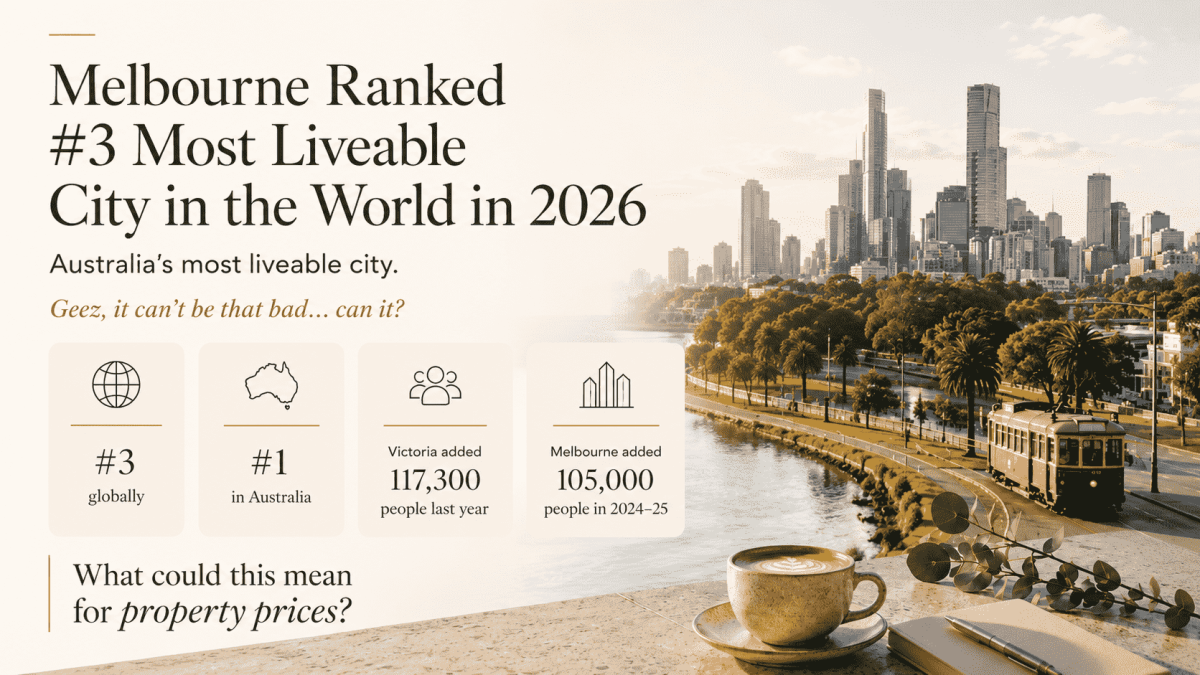
Melbourne has officially been ranked the third most liveable city in the world for 2026, making it the most liveable city in Australia.
The Economist Intelligence Unit’s Global Liveability Index placed Melbourne behind only Copenhagen and Vienna, while Sydney came in fourth and Adelaide eighth. In other words, three Australian cities made the global top ten, but Melbourne remains the country’s highest-ranked city.
Not bad for somewhere we are regularly told nobody wants to live anymore.
This Was Not Decided Over a Latte
The EIU assessed 173 cities using more than 30 indicators across stability, healthcare, culture and environment, education and infrastructure.
Melbourne achieved an overall score of 97 out of 100, including perfect scores for healthcare and education, plus 96 for both infrastructure and culture and environment.
So, while we may occasionally complain about the weather having four personalities before lunchtime, Melbourne continues to perform exceptionally well in the areas that genuinely influence where people choose to live, work, study, raise families and invest.
And Yes, People Are Still Coming
The population figures make the story even more interesting.
Victoria’s population increased by approximately 117,300 people during the year ending December 2025. That was the largest numerical increase of any Australian state, ahead of New South Wales, which added 104,600 people, and Queensland, which added 92,200.
There is an important technical distinction, however. Victoria did not record the country’s largest gain from interstate migration. Its net interstate migration figure was slightly negative at around 685 people.
Victoria’s growth was instead driven primarily by 85,044 people from net overseas migration, together with a natural population increase of 32,956.
Therefore, the accurate statement is:
Victoria added more people to its population than any other Australian state last year, although they did not all arrive from another state.
At the city level, the result is even more compelling. Greater Melbourne added approximately 105,000 residents during 2024–25, the largest population increase of any Australian capital city. Sydney added around 75,200, Brisbane 58,200 and Perth 58,100.
Geez, it really cannot be that bad.
What Could This Mean for Melbourne Property?
People need somewhere to live. It is not terribly complicated.
A growing population creates additional demand for rental properties and, over time, owner-occupied housing. Melbourne’s high liveability ranking also supports its ability to attract students, skilled workers, businesses and families from around Australia and overseas.
That does not mean a liveability trophy causes property prices to jump overnight. Sadly, the EIU does not arrive at settlement with an extra cheque.
In the short term, property prices are also influenced by interest rates, borrowing capacity, consumer confidence, taxation, government policy and the number of properties available for sale.
That is exactly what we are seeing now. During the June quarter of 2026, metropolitan Melbourne’s median house price declined 3.1 per cent to $952,500, while the median unit price fell 2.1 per cent to $643,500, following five consecutive quarters of growth. At the same time, outer Melbourne and regional Victoria continued to record stronger annual results.
This is not necessarily a contradiction. It demonstrates the difference between short-term market sentiment and long-term market fundamentals.
Melbourne can experience a softer property cycle while continuing to add more residents than any other capital city. In fact, that mismatch may create opportunities for buyers who can recognise long-term value while others remain distracted by today’s headlines.
Liveability Does Not Rescue the Wrong Property
Of course, population growth will not benefit every property or suburb equally.
Buyers still need to focus on established communities with employment, transport, education, amenity and limited competing housing supply. Property selection remains critical because a global liveability ranking will not fix an unsuitable location, an oversupplied development or a terrible floorplan.
But when a city is ranked third in the world for liveability, records Australia’s largest capital-city population increase and sits within the state that added more residents than any other, it becomes difficult to argue that Melbourne has somehow lost its appeal.
The Melbourne Reality
Yes, Victoria has challenges. Government policy matters. Higher costs matter. Interest rates matter. The current softness in parts of the property market is real and should not be ignored.
But neither should the fundamentals.
Melbourne remains Australia’s most liveable city, one of the most liveable cities on the planet and the capital city attracting the largest number of additional residents.
So perhaps Melbourne is not broken after all.
Perhaps it is simply experiencing one of those periods when the headlines are louder than the opportunity.
Buy Smarter. Live Better.
This article contains general property-market information only and should not be relied upon as financial, taxation, legal or investment advice.
About the Author
Shannon Koetsveld is the founder of The Property Effect and a Melbourne-based buyer’s agent who helps home buyers and investors purchase property with strategy, due diligence and confidence. She provides practical, market-aware guidance to help clients understand their options, reduce risk, make informed decisions and secure properties aligned with both their lifestyle needs and long-term financial goals.
To contact Shannon Koetsveld, click here.