

Sales growth rarely stalls because people stop trying. It usually stalls because the sales approach that worked early on no longer works as the business grows.
In the early days, momentum often comes from the founder, a few strong performers, and a steady flow of referrals. That can carry a business surprisingly far. The challenge is that informal selling does not scale.
As companies grow, what once drove success can begin to limit it. Revenue becomes uneven, forecasting becomes difficult, and leaders lose visibility into what is actually happening inside the pipeline.
Understanding why this happens is the first step towards building predictable, scalable revenue.
Why Sales Growth Stalls
Early growth often depends on founder-led selling or a handful of strong performers. That approach can work very well in the beginning, but it rarely scales as the organisation grows.
When more people join the team, informal selling habits start to break down. Each person develops their own approach, messaging drifts, and performance becomes inconsistent.
Without a defined strategy and repeatable process, teams struggle to maintain momentum. Leads fall through the cracks, deals stall without clear reasons, and forecasting becomes little more than educated guesswork.
Common contributors to stalled sales growth include:
- Referral dependency Early growth is often fuelled by referrals and existing relationships. When that source slows, many organisations discover they have no structured way to generate or qualify new opportunities.
- Overreliance on key individuals If revenue depends heavily on the founder or a few high performers, the business becomes fragile. Growth becomes difficult to sustain and almost impossible to scale.
- Sales infrastructure gaps Without a well-designed CRM and supporting processes, leaders lack the visibility needed to manage the pipeline, forecast reliably, and adjust as the organisation grows.
When the Sales Team Misses Targets
When growth slows, the first visible sign is usually missed targets or uneven performance across the team.
In many cases this is interpreted as a problem with effort or capability. More often it reflects deeper structural issues in the sales system itself.
Common contributors include:
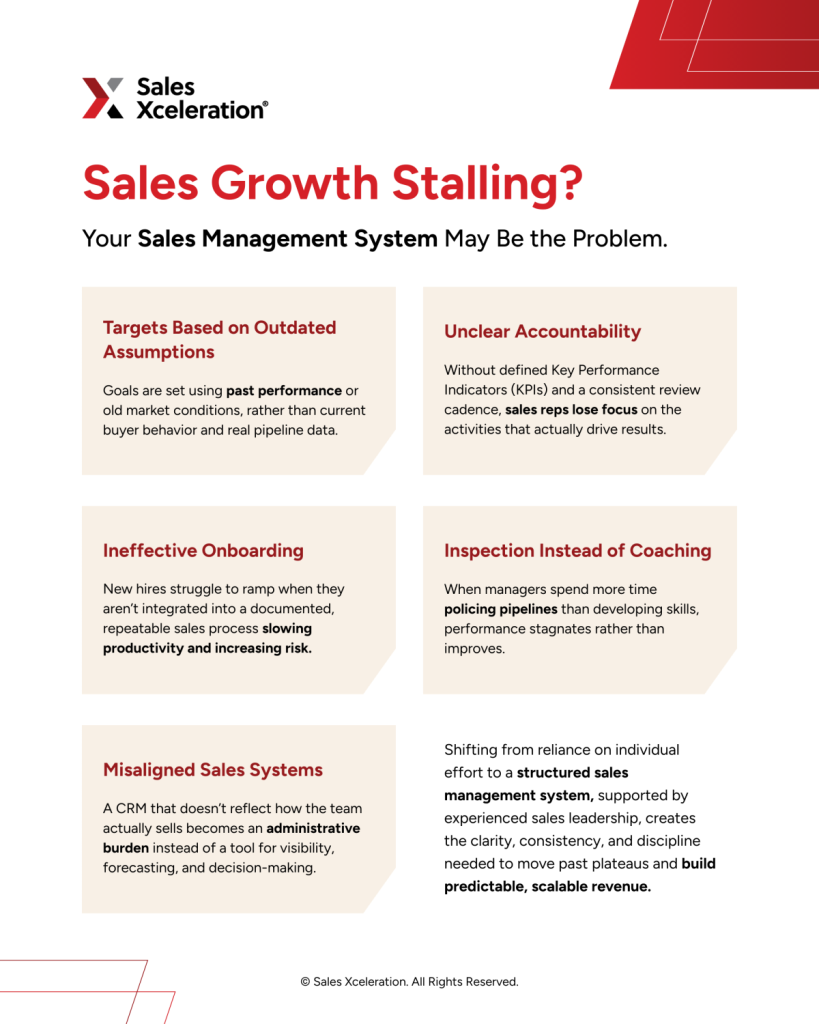
- Targets built on outdated assumptions Goals are often based on historical performance rather than current buyer behaviour or real pipeline data.
- Unclear accountability Without clear KPIs and regular performance reviews, salespeople lose focus on the activities that actually move deals forward.
- Ineffective onboarding New hires struggle to ramp when there is no documented process to guide how the organisation sells.
- Inspection instead of coaching When managers focus mainly on policing the pipeline rather than developing capability, performance tends to plateau.
- Misaligned systems A CRM that does not reflect how the team actually sells becomes an administrative burden rather than a tool for insight and decision making.
Scaling Revenue Means Scaling the System
Many organisations respond to slowing growth by hiring more salespeople. Unfortunately, adding headcount rarely solves the underlying issue.
If the system is weak, more people simply create more inconsistency.
Sustainable growth requires a sales structure that can support more people, more deals, and more complexity without breaking.
Key elements usually include:
- Role specialisation As volume increases, expecting one person to prospect, qualify, close, and manage accounts becomes inefficient. Clear role separation improves focus and accountability.
- A defined sales playbook High-performing teams map the buyer journey to clear actions, messaging, and exit criteria. This reduces guesswork and improves conversion rates.
- Data-driven coaching Effective leaders use leading indicators and deal-level insight to coach early, rather than reacting after results are missed.
- Structured onboarding and enablement New hires ramp faster when they understand how buyers make decisions and how the organisation’s sales process supports that journey.
- Consistent customer messaging Clear and consistent language builds buyer confidence and allows performance to be measured across the team.
When to Bring in Sales Leadership
A common challenge for growing companies is recognising when dedicated sales leadership becomes necessary.
Hire too early and the organisation may not yet have enough structure to support the role. Hire too late and growth stalls because no one owns the sales system.
When leadership is missing, growth relies on effort. When leadership is present, growth relies on structure.
Signs that a Fractional Sales Leader may be needed include:
- The founder remains the bottleneck Key deals still depend on the founder closing them personally.
- The business needs a builder, not just a manager The priority is designing and strengthening the sales system rather than supervising day-to-day activity.
- Sales ownership is unclear No one is responsible for process design, pipeline health, forecasting, compensation structure, or performance consistency.
- The team has reached a scale point For many organisations this occurs when the sales team grows to around five to ten people, depending on market complexity.
An effective sales leader does not simply manage people. They build the system that allows the team to perform consistently.
The Bottom Line
When sales growth stalls, it is rarely a people problem. It is usually a signal that the sales system has not evolved with the business.
Moving from reliance on individual effort to a structured sales management system brings clarity, discipline, and consistency. That shift is what allows revenue to become predictable and scalable.
If you are seeing growth slow or performance become uneven, it is worth stepping back and asking a simple question.
Is the problem really the sales team, or is it the system supporting them?
If you would like a structured assessment of where the gaps may be, I am always open to a conversation.
About the Author
Dominic Parsonson is the founder of Macidton Consulting and a Fractional Sales Leader who works with business owners and executive teams to strengthen underperforming or inconsistent sales functions. He helps SMEs put the right strategy, structure, process and accountability in place so sales become more predictable, scalable and easier to manage. With a practical, hands-on approach, Dominic supports clients to improve pipeline visibility, lift conversion performance and build a sales system that delivers with greater clarity and confidence. To contact Dominic click here